Software that supports your work. And your next step.
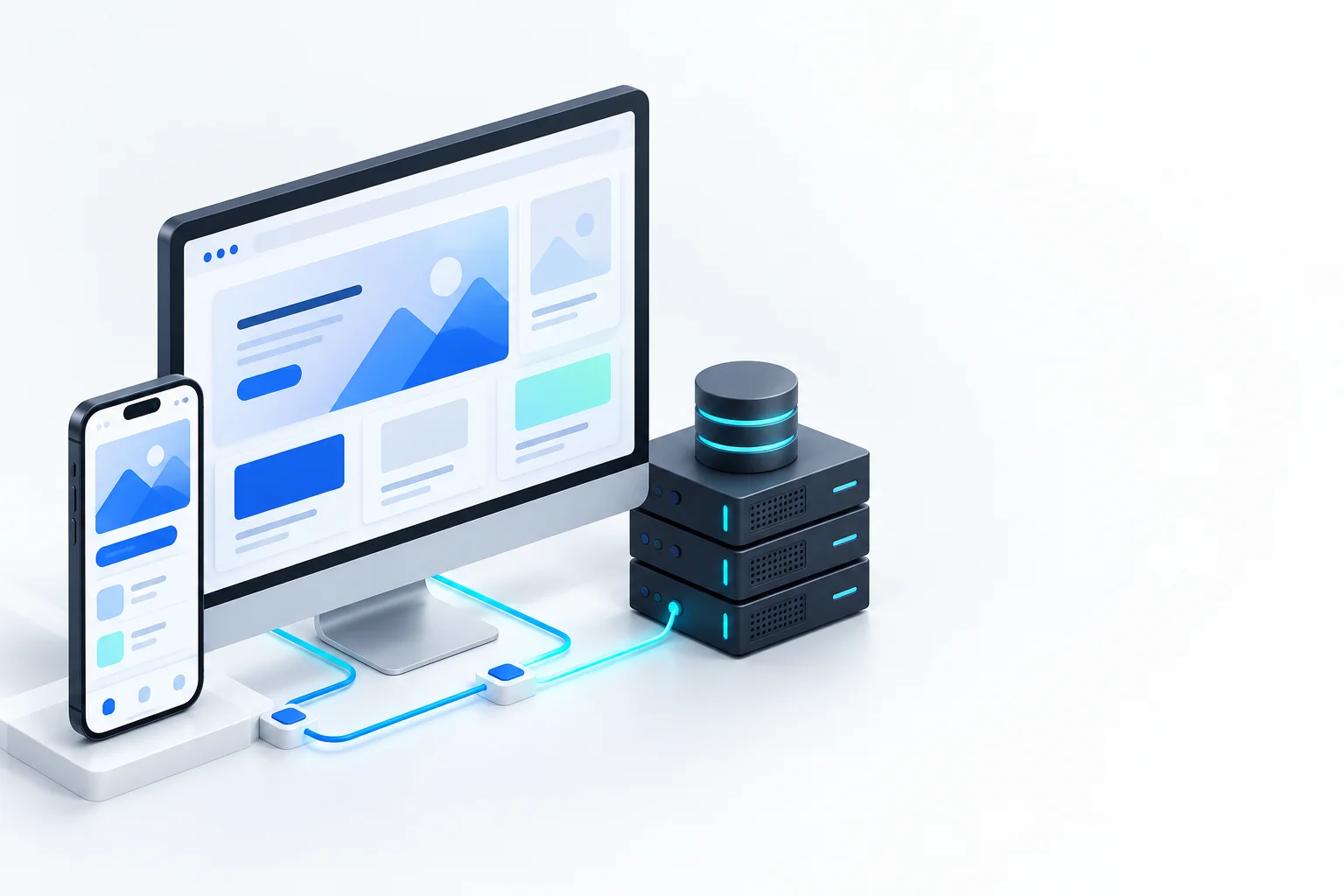
RAWJ Software develops websites, mobile applications and custom systems that connect customer experience with business operations. We start with the problem before choosing technology: what do users need, which steps can be simplified, and which data needs to move between systems? The answers become a defined scope and a testable experience.
Development services shaped around the project
Not every business needs a new app, and not every requirement fits an off-the-shelf product. We compare the alternatives and define a useful scope without unnecessary complexity. These services are agreed individually, not bundled into a mandatory package.
01
Website design and development
A company website is a working point of contact, not just a visual identity. We organise content and navigation and design responsive experiences for mobile and desktop. A project can include service pages, enquiry forms, content management and Arabic/English support, with crawlability and indexing considered during development.
Information architecture and UI/UX design
Responsive interfaces and clear forms
Technical SEO and content management within scope
02
Ecommerce development
We establish whether a hosted commerce platform is sufficient or the shopping journey needs custom development. We review catalogues, product pages, carts and checkout before defining payment, inventory and shipping connections. Merchant approval and payment-method activation remain subject to the provider.
Consistent product and shopping experiences
Payment, order and inventory integrations
Success, failure and cancellation testing
03
Mobile app development
Mobile development begins with the use case, not simply the operating system. We map screens and workflows, then assess iOS, Android or a cross-platform approach. Notifications, accounts, backend connections and store submission requirements are defined before implementation. Publication remains subject to store policies.
User journeys and interactive prototypes
Backend services and database connections
Device testing and launch preparation
04
Custom business software
When operations are spread across spreadsheets, messages and disconnected tools, a tailored system can bring them into a clearer workflow. We analyse roles, approvals, data and reporting to develop client portals, dashboards and internal tools. A complete ERP or CRM is not implied unless expressly included in scope.
Role-based access for your team
Operational workflows, approvals and reports
Data imports and a defined migration plan
05
API integrations and system connections
Connect existing tools instead of entering the same information repeatedly. Planning identifies the source of truth, authentication method and what should happen when a service is slow or unavailable. We use supported provider interfaces and consider usage limits and API version changes.
Documented APIs and webhooks
Failure handling and duplicate prevention
Credentials kept out of the user interface
06
Workflow automation and existing-system development
Improving a working system may be more useful than replacing it. We review repetitive tasks and error-prone handoffs and propose focused automation, such as routing a request, updating a status or preparing a report. Existing website improvements depend on a review of code access, hosting and technical dependencies.
Repetitive task and approval automation
Technical review of code and data flows
Incremental changes that respect current operations
Website, application and operations. Connected.
Value comes from clear data flows, not the number of tools. We define what users submit, where information lives, who may access it and which service performs the next action. This is an illustrative architecture; your actual design follows a requirements review.
01
Website or app
02
API layer
03
Data & permissions
04
Business tools
Example: a website request is reviewed in an admin workspace, then passed to a connected system with a recorded status and protection against duplicate entries.
Quality is not a final-stage task
We agree reviewable acceptance criteria before launch. Testing and handover depend on data sensitivity, usage and integrations rather than assuming every project needs identical arrangements.
Usability and accessibility
Review readable forms and copy, keyboard navigation, colour contrast and behaviour at agreed screen sizes. Loading, error and success states should make the next action clear.
Data security and access
Plan input validation, permission boundaries and protection of integration credentials. Backup, logging and retention requirements depend on the system and hosting. No system comes with an absolute guarantee against every attack.
Performance and technical SEO
Consider image and asset size, layout stability, titles, descriptions, canonical URLs and sitemaps where relevant. These foundations help people and search engines but do not guarantee a search ranking.
Testing and clear handover
Review core workflows and exceptional cases. The agreement defines source code, documentation, hosting accounts, training, acceptance fixes and any maintenance requiring a separate arrangement.
How does a development project work?
01
Understand the business
Gather goals, users, existing tools and constraints. Separate essential launch requirements from improvements that can follow later.
02
Define scope and prototype
Map workflows and key screens. Document deliverables, integrations, fees, milestones and change requests before development begins.
03
Develop and integrate
Deliver reviewable stages, separate testing from production where needed, and track dependencies and client-owned service accounts.
04
Test, launch and hand over
Review acceptance criteria and prepare the launch and handover plan. Agree hosting, support, maintenance and update responsibilities before going live.
What determines development cost and timeline?
Screen count alone does not price a software project. User permissions, data complexity, external integrations, languages, content migration and testing requirements affect the work involved. We prepare a proposal after reviewing requirements and separate development fees from hosting, platform subscriptions and third-party provider charges.
Off-the-shelf or custom development?
A ready-made product may suit familiar workflows that can adapt to the platform. Custom software becomes more relevant when permissions, journeys or integrations are not covered by available tools. A combined approach can work too: an existing platform with a focused custom integration instead of rebuilding everything.
Website and application development questions
Do I need a website or a mobile app?
It depends on how people use the service. Websites can suit direct access, search and sharing, while an app may support repeat use or device-specific features. We review the journey before proposing a solution; launching both may not be necessary.
Can a project support Arabic and English?
Scope can include RTL and LTR layouts, equivalent pages, URLs and metadata. Content ownership, translation and language management are agreed before development.
Does website development include SEO?
A project can cover technical foundations such as titles, indexing, URLs, performance and images. Ongoing content strategy and organic search work have a separate agreed scope. We do not promise a first-place Google ranking.
Can you integrate a payment gateway or another service?
We review provider documentation, supported currencies and methods, merchant approval and account permissions. Integration depends on suitable interfaces and access; provider fees and approvals are outside the development team's control.
Can we develop the system in stages?
Yes. Define an initial release with essential functionality and prioritise subsequent additions. This allows real usage to inform investment, with data and integration design reflecting the agreed roadmap.
Who owns the code and service accounts?
Source ownership, licences, repository access, hosting and external service accounts are specified in the proposal or contract. We do not assume every third-party subscription or licence is transferable.
Are maintenance and support included?
Any acceptance-fix period is distinguished from new functionality and ongoing maintenance. A separate support arrangement can be agreed around the system's operational needs.
Can I request technical consulting before development?
Yes. RAWJ Consulting can assess an idea, review a system or compare alternatives without requiring you to commission RAWJ Software for implementation.
Tell us about your software project
Share your goal and core requirements so we can discuss a suitable next step. You do not need to know technology names to start the conversation.